Saturday, April 4, 2009

Fuel economy and your wallet


Driving More Efficiently
Drive Sensibly
frustrated driverAggressive driving (speeding, rapid acceleration and braking) wastes gas. It can lower your gas mileage by 33 percent at highway speeds and by 5 percent around town. Sensible driving is also safer for you and others, so you may save more than gas money.

Fuel Economy Benefit:
5-33%

Equivalent Gasoline Savings:
$0.10-$0.65/gallon

Observe the Speed Limit
Graph showing MPG VS speed MPG decreases rapidly at speeds above 60 mphWhile each vehicle reaches its optimal fuel economy at a different speed (or range of speeds), gas mileage usually decreases rapidly at speeds above 60 mph.
You can assume that each 5 mph you drive over 60 mph is like paying an additional $0.24 per gallon for gas.
Observing the speed limit is also safer.

Fuel Economy Benefit:
7-23%

Equivalent Gasoline Savings:
$0.14-$0.45/gallon

Remove Excess Weight
Excess items in trunkAvoid keeping unnecessary items in your vehicle, especially heavy ones. An extra 100 pounds in your vehicle could reduce your MPG by up to 2 percent. The reduction is based on the percentage of extra weight relative to the vehicle's weight and affects smaller vehicles more than larger ones.

Fuel Economy Benefit:
1-2%/100 lbs

Equivalent Gasoline Savings:
$0.02-$0.04/gallon

Avoid Excessive Idling
Idling gets 0 miles per gallon. Cars with larger engines typically waste more gas at idle than do cars with smaller engines.

cruise controlUse Cruise Control
Using cruise control on the highway helps you maintain a constant speed and, in most cases, will save gas.

Use Overdrive Gears
When you use overdrive gearing, your car's engine speed goes down. This saves gas and reduces engine wear.

Note: Cost savings are based on an assumed fuel price of $1.96/gallon.
Data Sources
Estimates for fuel savings from sensible driving are based on Energy and Environmental Analysis, Inc., Owner Related Fuel Economy Improvements, Arlington, Virginia, 2001.
Estimates for the effect of speed on MPG are based on a study by West, B.H., R.N. McGill, J.W. Hodgson, S.S. Sluder, and D.E. Smith, Development and Verification of Light-Duty Modal Emissions and Fuel Consumption Values for Traffic Models, Oak Ridge National Laboratory, Oak Ridge, Tennessee, March 1999.

Some gas saving tips


Driving More Efficiently
Drive Sensibly
frustrated driverAggressive driving (speeding, rapid acceleration and braking) wastes gas. It can lower your gas mileage by 33 percent at highway speeds and by 5 percent around town. Sensible driving is also safer for you and others, so you may save more than gas money.

Fuel Economy Benefit:
5-33%

Equivalent Gasoline Savings:
$0.10-$0.65/gallon

Observe the Speed Limit
Graph showing MPG VS speed MPG decreases rapidly at speeds above 60 mphWhile each vehicle reaches its optimal fuel economy at a different speed (or range of speeds), gas mileage usually decreases rapidly at speeds above 60 mph.
You can assume that each 5 mph you drive over 60 mph is like paying an additional $0.24 per gallon for gas.
Observing the speed limit is also safer.

Fuel Economy Benefit:
7-23%

Equivalent Gasoline Savings:
$0.14-$0.45/gallon

Remove Excess Weight
Excess items in trunkAvoid keeping unnecessary items in your vehicle, especially heavy ones. An extra 100 pounds in your vehicle could reduce your MPG by up to 2 percent. The reduction is based on the percentage of extra weight relative to the vehicle's weight and affects smaller vehicles more than larger ones.

Fuel Economy Benefit:
1-2%/100 lbs

Equivalent Gasoline Savings:
$0.02-$0.04/gallon

Avoid Excessive Idling
Idling gets 0 miles per gallon. Cars with larger engines typically waste more gas at idle than do cars with smaller engines.

cruise controlUse Cruise Control
Using cruise control on the highway helps you maintain a constant speed and, in most cases, will save gas.

Use Overdrive Gears
When you use overdrive gearing, your car's engine speed goes down. This saves gas and reduces engine wear.

Note: Cost savings are based on an assumed fuel price of $1.96/gallon.
Data Sources
Estimates for fuel savings from sensible driving are based on Energy and Environmental Analysis, Inc., Owner Related Fuel Economy Improvements, Arlington, Virginia, 2001.
Estimates for the effect of speed on MPG are based on a study by West, B.H., R.N. McGill, J.W. Hodgson, S.S. Sluder, and D.E. Smith, Development and Verification of Light-Duty Modal Emissions and Fuel Consumption Values for Traffic Models, Oak Ridge National Laboratory, Oak Ridge, Tennessee, March 1999.

Thursday, April 2, 2009

When to flush your transmission

There are several subjects that tend to be a never-ending source of confusion. One that constantly comes up is changing or flushing the transmission fluid in the Toyota truck transmission. As usual most of the people that are confused and causing the confusion are Toyota Certified Technicians and service reps.
I have seen the inside of my transmission while it was torn down at Level 10 having its upgrades installed. When it was reinstalled in my truck with its new performance torque converter, Level 10 put in 12 quarts for fluid. When I got home I put another 3 quarts in to bring up to the full mark. Now if you were counting that is a total of 15 quarts of fluid.
If you decide to change the fluid like you should, you cannot get all the fluid out by draining the pan. When you drain the pan through the drain plug you will only drain about 3 of the 15 total quarts. That is not much of a fluid change at all. Most of the fluid is inside the torque converter, transmission cooler and the cooler lines. Some vehicles like Mercedes have a drain plug on the torque converter so it can be drained, but not on our Toyotas. There is only one way to get all the fluid out of the transmission so you can replace it with new fluid. That is to flush it.
There seems to be as much bad info out there about transmission flushes as there is about synthetic motor oil. The number of professional mechanics that claim that a flush will blow out the seals and cause damage to the transmission dumbfounds me. Those poor people are suffering from invincible ignorance and refuse to understand the benefit of a proper transmission flush.
Here is the BIG secret about transmission flush machines. They do not use pressure at all. They use the transmissions own pump to move in the new fluid that displaces the old fluid and the old fluid is collected and thrown away. There are two basic types of flush machines and here is how they work and the differences in the two
Cooler line flush machine:
The first type of flush machine connects into the transmission cooler lines. BG makes this kind and here is how it works. The line going from the transmission to the transmission cooler is disconnected and connected to the machine line in. The line out from the machine carrying new fluid is connected to the line going to the cooler. There is a chamber on the machine that has a diaphragm in it. The top part of the chamber above the diaphragm is filed with new fluid. The engine is started which turns the torque converter and the input shaft on the transmission. The input shaft turns the transmission pump and it makes hydraulic pressure. This causes fluid to flow through the cooler line. As fluid leaves the cooler line it enters the chamber on the flush machine. As the old fluid side of the diaphragm fills it pushes the diaphragm up and forces new fresh fluid into the transmission. After a while the old fluid is collected in the machine and it is replaced by new fluid. Now the transmission has been flushed. Really pretty simple. As you can see the machine cause no pressure and all fluid transfer is done by the transmission�s own pump.
Here is what I do not like about this type of machine. When the fluid leaves the transmission pump it passes to two different pressure regulators. One regulator supplies fluid at one pressure to the transmission itself that operates the pistons and controls gear shifting. The other is supplies the torque converter and the transmission cooler. So you can see that all the fluid leaving the pump does not go to the cooler. A bunch of it is cycled through the transmission and dumped back to the pan without going through the cooler. This type of flush machine does not remove all the old fluid, but it continuously dilutes it down with new fluid. It never really removes all of the old fluid, but is far superior to just drain and fill.
The other thing I do not like about this type of flush is that they sell the supposed benefit that they do not have to drop the pan and change the filter like that is a benefit. Dropping the pan is very important. Looking in the pan is a fantastic diagnostic tool that can tell you if something is going wrong in your transmission. Now lets say some crud is flushed out of the trans with this flush method. Where does it go? It can go into the pan, and then sucked up into the filter that may clog the filter causing the pump to starve for fluid and a pressure loss. On the engine the filter is after the pump and if the filter gets clogged there is a bypass valve that opens and oil bypass the clogged filter so the engine is still supplied with oil. Unlike the engine oil pump and filter the filter is on the intake side of the pump. If it gets clogged, that is it, it is clogged and stuff does not get lubricated and the clutches do not get enough clamping pressure and they slip and burn up. In just a faction of a second you just bought a new transmission if the filter clogs.
Pump inlet flush machine:
Now lets talk about the type of flush machine I like. This kind attaches to the pump intake after the pan and filter is removed. This machine only supplies fresh new fluid to the pump intake and as the fluid passes through the transmission it dumps out to a collection tray and never goes back through for a second pass. All of the old fluid and crud is GONE and replace with fresh new fluid. After the service a new filter is installed, the pan replaced and then it is topped off with new fluid to the proper level on the dipstick.
This process takes a total of 20 quarts of fluid to flush out 15 quarts of old fluid, replaces the fluid, and gives the mechanic the opportunity to look in the pan for anything unusual that would indicate a pending failure.
Everyone should have this type of service done every 30,000 miles, but definitely before your truck goes out of warranty. By looking in the pan you may get an indication that you are about to have transmission trouble that might show up right after you get out of warranty.
I will tell you that this type a flush does take more effort and makes more of a mess, costs a little more, but I think it is worth it
Fluid:
Now the last big question that remains is what type of fluid to put back in, conventional or synthetic. For lots of different reasons that is an easy answer, synthetic. Premium synthetic fluid will lubricate the transmission better, provide better traction to the clutches, removes heat better, and not break down as fast under high temperatures. Premium synthetic ATFs will protect better and last 3-5 times longer then conventional ATF. When my transmission with being reinstalled in my truck at Level 10, I asked Pat the owner what he thought about AMSOIL ATF. He said that is was the very best ATF in the world. I will let you guess what I use

Filter and pan gasket:

The filter should be changed with the fluid, just like motor oil filters. I got an e-mail from a guy that said he was told by a Toyota Service Rep that there is no filter in the transmission. The amazement continues. There are some transmissions out there that do not have replaceable filters, but this is not one of them.
When the filter is replaced it has to be done with care. There are three ports on the filter where the fluid passes into the transmission. Each has its own gasket. It is common for at least one of these gaskets to slip out of position during installation and cause air to leak into the pump pick up causing it to break suction and loose output pressure. The problem usually presents after hard stops and the transmission will not complete its shift into first. Then when you go to pull off the engine revs and then the transmission engages very harshly with a tire chirp. Just make sure they are all properly positioned during replacement.
The pan does not use a gasket, but many shops will try to install a cork one. Toyota uses their own seal packing material that is available from the parts counter. It is similar to RTV. They have two kinds, black and red. The black is for the engine and water pump and the red is for the transmission. I use something that I think is a little better. It is made by Permatex called �Right Stuff� and comes in a cheese whiz can. This is fantastic stuff and does not require any drying time before you refill the transmission. It is available from most parts stores. Be careful when reinstalling the pan bolts, as they are easy to strip.

WHEN NOT TO DO A TRANMISSION FLUSH:
Before draining or flushing you should pull the dip stick and look at the fluid. If it is dark, burnt smelling, and you see little flakes or speck in it, DO NOT FLUSH IT. The fluid and transmission is TOAST, but the transmission just has not figured out it should die yet. In these cases for reasons no one has figured out yet, if you flush a transmission in this condition it will fail right away. Real strange, but that is what seems to happen. If your trans is in this condition just drive it while you save for a replacement transmission. There is no way of telling when it will fail. It might be today, next week, or next year, but it is doomed.
The goal here is to flush the trans BEFORE the fluid gets rancid. What you are taking out should look like what you are putting in. Do not wait for a color or smell change. My 4Runner Owner's Manual calls for transmission fluid change at 30,000 mile intervals. The industry standard it two years OR 24,000 miles which ever comes first. It is your truck, you decide what is best for you

Monday, February 9, 2009

When should you tune up your car

Is it time for a Tune-up Yet?
It's been a couple of years since you has the car tuned up but it still seems to be running fine. Leave well enough alone, right?
WRONG!
On most vehicles today, malfunctions may be camouflaged by computers whose function is to keep the engine running as efficiently as possible as long as possible. When they no longer can compensate for mechanical discrepancies, they may just fail. The vehicle is disabled. Periodic diagnostic checks and maintenance can prevent this sometimes disastrous situation.
Symptoms of engine trouble on most vehicles today are subtle. It's not easy to tell if your car needs a tune-up because the symptoms are masked by computerized controls. Preventive diagnosis, done periodically, can keep your vehicle running trouble-free for years. Short of that, if you do detect a change in your vehicle's performance, make a note of it and report it to your technician for further diagnosis and corrective measures.

Power Loss
How long since the fuel filter was changed? A dirty filter is a common cause of power loss. As noted under "poor gas mileage", there can be many causes of this condition, most of which can be located with a diagnostic procedure.
Poor Gas Mileage
By keeping a regular check of gas mileage (miles driven divided by gallons used) you can tell if your engine is losing efficiency. Increased gas consumption may be accompanied by other symptoms listed in this pamphlet.
NOTE
Poor gas mileage also may be due to:
• Under inflated tires
• Engine running too cold
• Transmission malfunction
• Dragging brakes
• Misaligned wheels
Stalling
This can be caused by incorrect idle speed adjustments, a malfunctioning sensor or switch, dirty fuel system parts, spark plugs or other engine deficiencies.
Does it stall when:
• Hot?
• Cold?
• With air conditioning on?
To make diagnosis easier, make note of when it happens and advise your technician.

Hard Starting
This is the most common form of car trouble. It's usually due to some unperformed maintenance. If the starter cranks the engine, the electrical system probably is ok. The culprit could be a starting sensor (on fuel injected models) or the choke mechanism (on engines with carburetors). Frequently, starting failure can be traced to an electronic component or a computer controlling the ignition system.
Knocking
This noise generally is heard when the engine is under load, such as when accelerating or climbing a hill. While it often may be caused by a tankful of inferior gas, ignition knock frequently is a sign your engine needs attention. It also can be caused by a build up of carbon inside the engine.
Late model cars are equipped with a knock sensor which "hears" the sound and makes corrective adjustments. But it cannot compensate for a severe malfunction, a condition which can affect engine performance, even damage the engine.

Remember: here at The Wright Import in Cumming,Georgia we are always available to serve you. Come by or call anytime.

The Wright Import Service Center

(770) 888-0100
2636 Business Dr, Cumming, GA 30040 Map it | Get directions Cross Streets: Near the intersection of Business Dr and GA-20
www.freewebs.com...

Does fuel injection cleaning work

The answer to that is most definitely yes. Deposit build-up can and will cause major problems! Without your realizing it, the response and performance that made your new car so much fun have slowly drained away. Deposits that build up in the fuel and air induction systems of the engine have robbed your car of its agility and excitement. Modern engines are finely tuned and extremely sensitive to deposits that accumulate on intake valves, intake ports, fuel injectors and combustion chambers.
Deposits in the fuel induction system cause drive-ability problems such as hesitation, surge, stall, hard starting, rough idle and loss of power.


The correct balance of fuel and air entering the combustion chamber is vital to engine performance. The air throttle body assembly controls the air flow into the intake ports where the air mixes with atomized fuel and swirls into the combustion chamber. Heavy deposits build-up on the back side of the throttle plate, around and behind the plate and in the idle air control. Deposits in the air induction system cause rough engine idle, excessive exhaust emissions and loss of performance.


Correct fuel/air ratio can be maintained only when the fuel and air induction systems are clean and free of deposits

Saturday, January 24, 2009

Top 10 hybrids

Gas-electric hybrids are among the most miserly rides on the road when it comes to fuel economy. But how do they compare to each other?\

Maybe we’re used to them by now: Hybrids silently sliding up behind us in the grocery store parking lot or on the street in front of the pharmacy, the only identification being a slight hum or a green badge on the tailgate. Whether they’ve become commonplace or not, we shouldn’t downplay that hybrid drive systems represent a colossal leap forward in terms of environmentally conscious automotive technology — and there have been only a handful of big jumps in the last century. Like that prehistoric guppy morphing into a landlubber, the addition of electric power is auto evolution in the making. In 2000 just one hybrid was available in the U.S. The 2009 model year has 20 from which to choose. But are all of them created equal?
We decided to put them to the test and wrangled up the 10 most efficient hybrids available in the U.S. We based our list on the Environmental Protection Agency’s fuel economy stats. Incidentally, these ratings have been updated starting with model year 2008. They are now more accurate, taking in real-world factors including cold weather, faster acceleration and air conditioner use. In fact, many drivers now find they get better mileage than what’s printed on the EPA window sticker. Here’s how the hybrids ranked:

Toyota Prius

2009 Toyota Prius (© Toyota Motor Sales, U.S.A.) Click picture to enlarge
Though the Toyota Prius sacrifices performance in the pursuit of fuel-efficiency, its interior is well-built and reasonably comfortable.
Love it or loathe it, the Prius is the most fuel-efficient car you can buy in America. The poster child for the green revolution is also the most popular hybrid in the world, with more than 1 million sold. The EPA ranks the 2009 model at 48/45 mpg (city/hwy). At its heart is Toyota’s Synergy Drive, which debuted in 2003. It is the same technology found in the Toyota Camry and Highlander hybrids, and also is licensed by Nissan for their hybrids, as well as Ford, but to a lesser extent. The manufacturer’s suggested retail price for a 2009 Prius runs from $22,000 to $24,270, depending on trim level.

Related Content
First Drive: 2010 Honda Insight  // First Drive: 2010 Honda Insight  (First Drive: 2010 Honda Insight )First Drive: 2010 Honda Insight Honda introduces America’s lowest-priced hybrid.

2008 Honda Civic Hybrid (© American Honda Motor Co., Inc.) Click picture to enlarge
Honda's fuel-sipping Civic lineup has just been updated — albeit barely — for 2009 with a midcycle enhancement and the addition of two new sedan trim levels.
Honda’s Integrated Motor Assist pairs an i-VTEC engine with an electric motor, bumping the mpg up to 40/45 (city/hwy). With 90.9 cubic feet of passenger space and 10.4 cubic feet of storage, the Civic is slightly less spacious than the Prius. However, the hybrid Civic’s five-star frontal crash rating beats four stars for the Prius. The Civic Hybrid’s base MSRP is $23,550; leather and a nav system will bump you up to $26,750. Federal tax incentives are still available for the Civic Hybrid, but after the end of 2008 they’re gone. Prius incentives are already history.

Nissan Altima Hybrid

2008 Nissan Altima Hybrid (© Rod Hatfield) Click picture to enlarge
The Nissan Altima is largely unchanged for 2009, although the automaker is expanding availability of its gas-electric hybrid model.
Drivers demanding more performance should take a look at Nissan’s Altima Hybrid. With a 40-horsepower electric motor alongside its 2.5-liter 4-cylinder engine, it has the feel of a V6. But at 35/33 mpg (city/hwy), it doesn’t burn gas like one. With a $26,650 MSRP, the Altima is trying to give the hybrid Camry a run for its money, but only in the nine states where it’s available: California, New York, Massachusetts, Connecticut, Vermont, Oregon, Rhode Island, Maine and New Jersey.

Escape/ Tribute/ Mariner Hybrids (2WD)

2009 Ford Escape Hybrid (© Ford Motor Company) Click picture to enlarge
The Ford Escape, Mazda Tribute and Mercury Mariner Hybrids are basically all the same under the sheet-metal facade. Talk about two too many.
Although Ford claims its Escape Hybrid is “the most fuel-efficient SUV on the planet,” it is actually in a three-way tie with two other compact SUVs: the Mazda Tribute Hybrid and Mercury Mariner Hybrid. We’ll cover the triplets together, since they bear the same vital stats. The 2009 models of these three compact SUVs test at 34/31 mpg (city/hwy) in their front-wheel-drive models. However, all three compact hybrid SUVs drop to 29/27 mpg when adding four-wheel drive. All three carry the same 2.4-liter 4-cylinder engine that is paired with an electric motor and nickel-metal hydride battery pack. While these compact SUVs offer only a bit more passenger space than a Prius, there is much more cargo space to be found behind the rear seats.

Toyota Camry Hybrid

2008 Toyota Camry Hybrid Click picture to enlarge
Unchanged for 2009, the Toyota Camry is soft on sport and excitement, but offers good to great levels of comfort, convenience and options.
One of the most popular cars on the road — somewhat sexier after its 2007 redesign — the Camry Hybrid is also one of the most sought-after hybrids. A 105-kilowatt electric motor and 4-cylinder engine give this car considerably more punch in the pants than the Prius, and fuel economy of 33/34 mpg (city/hwy). The Camry also offers more cubic footage for passengers than its Prius sibling. A 2009 Camry Hybrid carries a base MSRP of $26,150.
its size to go gas-electric, the Highlander Hybrid treads the line between power and efficiency. A 3.3-liter V6 offers a net output of 270 horsepower. Even with standard 4WD, the hybrid Highlander rates at 27/25 mpg (city/hwy), with an MSRP ranging between $34,700 and $41,020.

Chevrolet Malibu Hybrid

2008 Chevrolet Malibu Hybrid Click picture to enlarge
Nicely designed inside and out, with solid overall performance and an attention to detail, the Chevy Malibu Hybrid is an example of what GM can do when motivated.
The hybrid incarnation of the Malibu is part of a growing family of American-made fuel-sippers. Driving a hybrid Malibu will feel different from a Prius or Camry. Aside from the aesthetics, Chevy’s gas-electric powertrain is what in industry jargon is called a “mild hybrid.” The car will get a burst from the electric motor during acceleration, and the battery will recharge during coasting and braking. The gas motor will also shut off when the car is at a standstill. But unable to run on electric power alone, this Malibu gets 26/34 mpg (city/hwy), a small improvement over the 22/33 mpg of the non-hybrid Malibu.
Related Content
First Drive: 2010 Honda Insight  // First Drive: 2010 Honda Insight  (First Drive: 2010 Honda Insight )First Drive: 2010 Honda Insight Honda introduces America’s lowest-priced hybrid.

2008 Saturn Aura Hybrid Click picture to enlarge
The Saturn Aura Hybrid possesses an attractive design inside and out, a quiet cabin, a comfortable ride and top safety scores, but fuel economy isn't what it could be.
Packing the same “mild hybrid” system and 4-speed automatic gearbox as the Malibu, Saturn’s 5-seat hybrid Aura offers the same 26/34 mpg (city/hwy). Both the Aura and Vue are part of Saturn’s growing family of hybrids, which was dubbed Green Line until the label was dropped this year. Saturn is claiming “very limited availability” for the Aura, but if you can find one you’ll meet an MSRP of $26,685.

Saturn Vue Hybrid

2009 Saturn Vue Hybrid (© General Motors) Click picture to enlarge
GM claims fuel economy for the Saturn Vue 2 Mode will be 50 percent better than that of the gas-only V6, and have a range of more than 500 miles.
The other hybrid feather in Saturn’s cap is the Vue, the first GM model to go hybrid back in 2006. A 2009 Vue Hybrid pulls in 25 mpg driving in the city, 32 mpg on the highway. The 2009 model year was supposed to see the Vue available with GM’s more advanced 2-Mode hybrid system—the same used in the Tahoe and Yukon hybrids. But financial trouble has delayed a 2-Mode Vue until the first quarter of 2009.

Lexus GS 450h

2008 Lexus GS 450h (© Toyota Motor Sales, U.S.A.) Click picture to enlarge
Lexus claims that the hybrid system in the GS 450h will perform like a 4.5-liter V8, producing substantially more than 300 horsepower and doing zero to 60 mph in less than six seconds.
Tuned for exhilaration rather than efficiency, the 450h packs a V6 alongside its Lexus Hybrid Drive. Lexus claims the car can leap from zero to 60 in 5.2 seconds, making it Lexus’ fastest hybrid. But it comes at a price, both in mpg and dollars. This rear-wheel-drive sport sedan tests at 22/25 mpg (city/hwy), and the MSRP starts at $56,400.

Sunday, January 11, 2009

Changing spark plugs in a Nissan Maxima

Changing the spark plugs on a 2002-2003 Maxima is not something you should have to do until around 100,000 miles. The stock plugs are platinum tipped and should last a very long time. Replacement of the plugs is something that Nissan recommends you "see your dealer" to do. The reason is that in order to replace the 3 plugs in the rear cylinder bank, the intake manifold upper and lower collectors have to be completely removed from the vehicle. To do this requires skill beyond the average Sunday mechanic, since there are many vacuum, electrical and coolant lines that have to come off in order to perform the job.
My Nissan had slightly over 18,000 miles on it when I did the job, and it did not really need new plugs. The reason I ended up doing this job was because I strongly suspected one or more of my ignition coils were faulty, and try as I might I could not get Nissan to admit the problem or come up with a solution. I called Courtesy Nissan, ordered a set of ignition coils and plugs, and set about doing the job myself. I replaced all 6 ignition coils, and doing the spark plugs as well was simply for the sake of completeness.
I documented the entire process with pictures and text so that if there is anyone out there who wants to do the same, perhaps they will not be quite as intimidated as if they were going in cold. The job is not simple, and took me about 3.5 hours, but I did take a lunch break, and was also documenting the process with a digital camera.
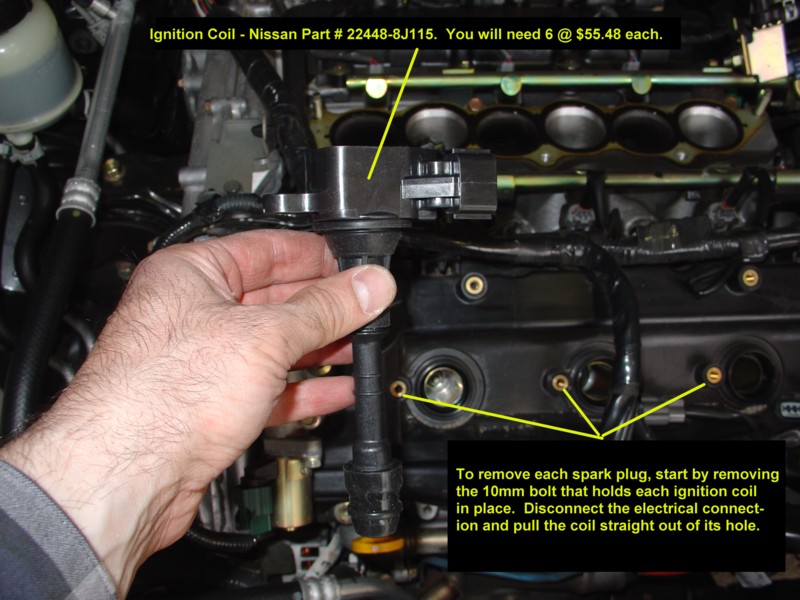
Cost of the job was also not cheap - a set of 6 ignition coils from Courtesy Nissan cost me $333.48. The required gasket is another $18.40. The plugs themselves will run you $11.00 each. If all you really need to do is change your plugs, obviously you don't need to buy coils, so then all you would need would be 6 plugs and the gasket. Do the job yourself and you will save quite a fortune in labor, as this job performed by the dealer would be many hundreds of dollars.
1
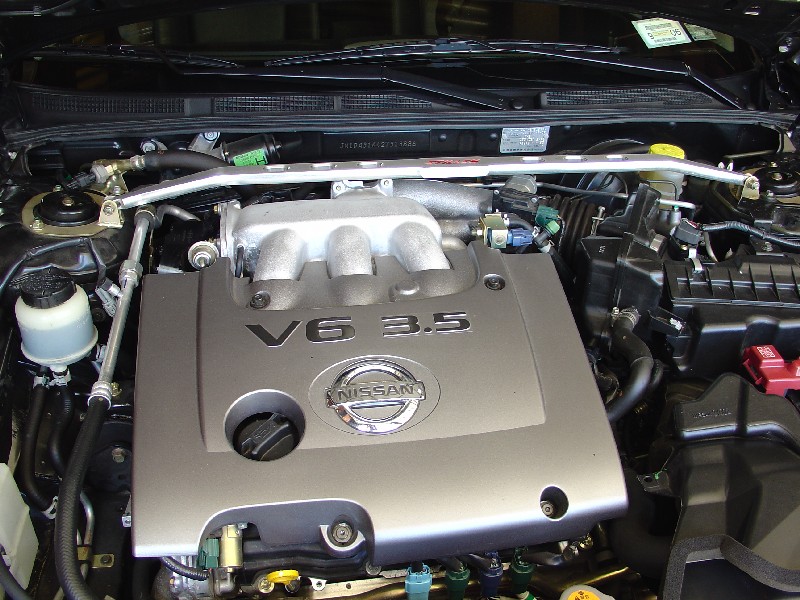
Here is the nice clean engine bay before going in with the chainsaw. If you have a front strut brace, as I did, it is probably not necessary to remove it, but I did simply to make it a little easier to lift the collector out. It only takes a minute or two anyway.
1
This pic still shows the strut brace in place (I removed it later). First step is to remove the 4 allen bolts securing the engine cover, and take it off.
3
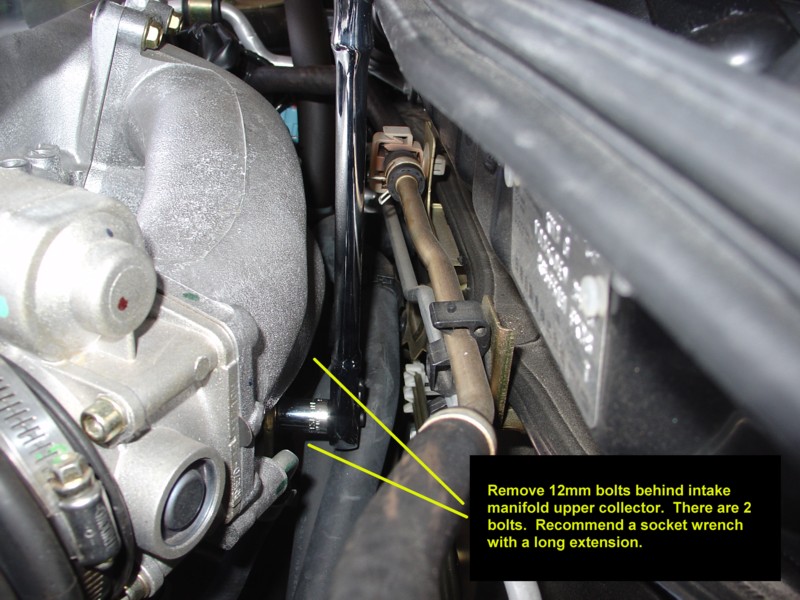
A view near the firewall. The test is if you can reach and loosen these two bolts then you can do the rest of the job. It requires a 12mm socket with a long handle.
4
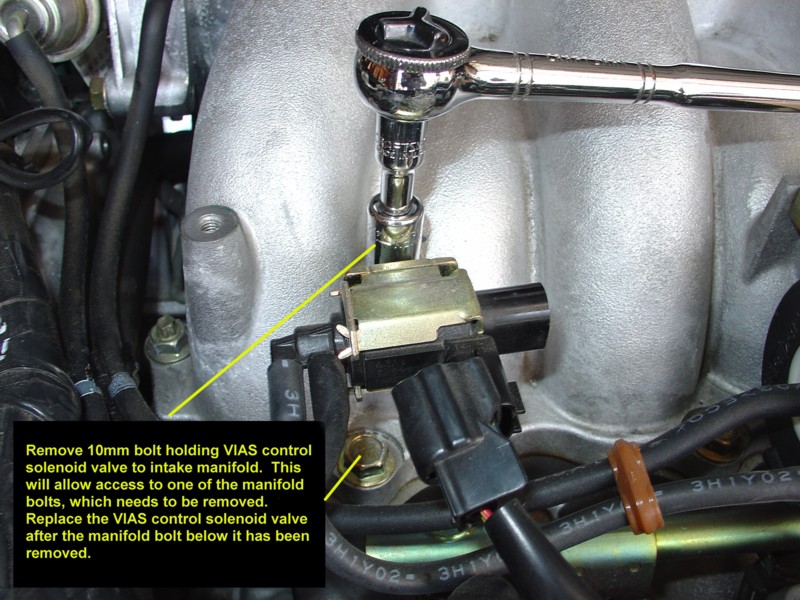
My method of doing this job will show you how it can be done without disconnecting so many vacuum lines, as I have seen others do. All you need to do is take a few parts off first so you can reach the bolts that attach the collector to the engine. Leave the electrical connector off, but put the valve back on.
5
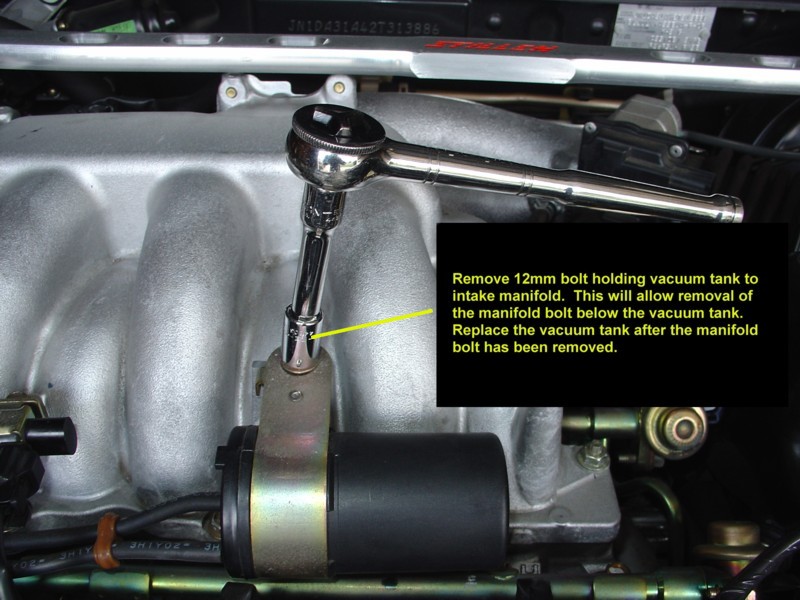
Same idea with the vacuum tank. Take it off only so you can reach the attachment bolts. Then put it, and the VIAS control solenoid valve back on.
6
Once you get these 3 bolts, and 2 nuts off, you can go ahead and put the VIAS and vacuum tanks back on the collector.
7
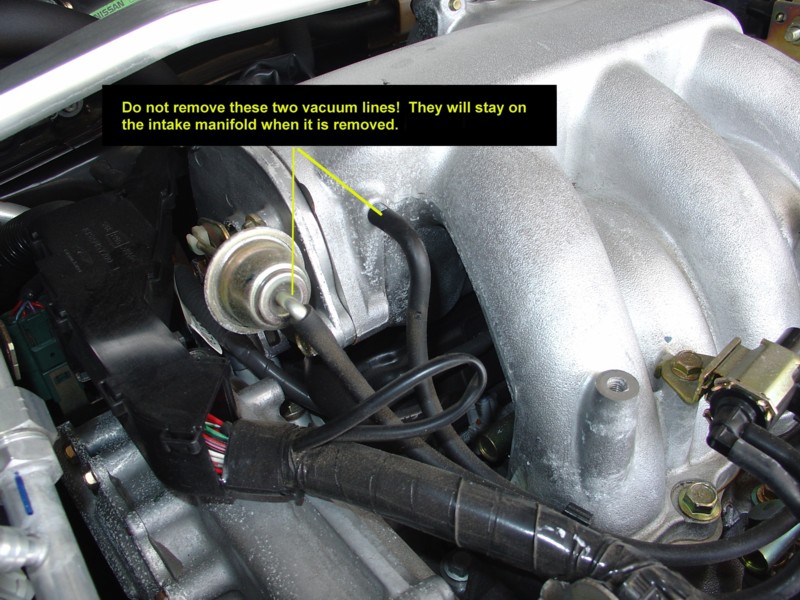
Don't take these off! No need to. You'll see why later.
8
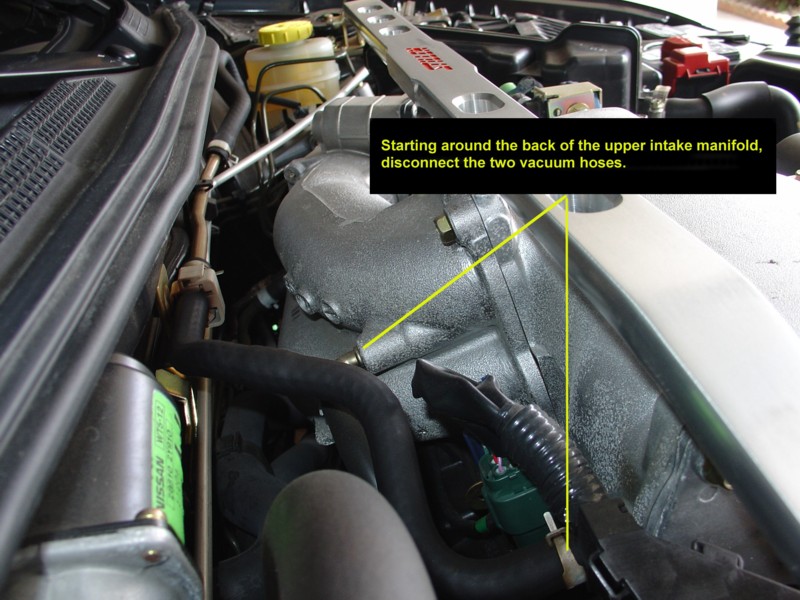
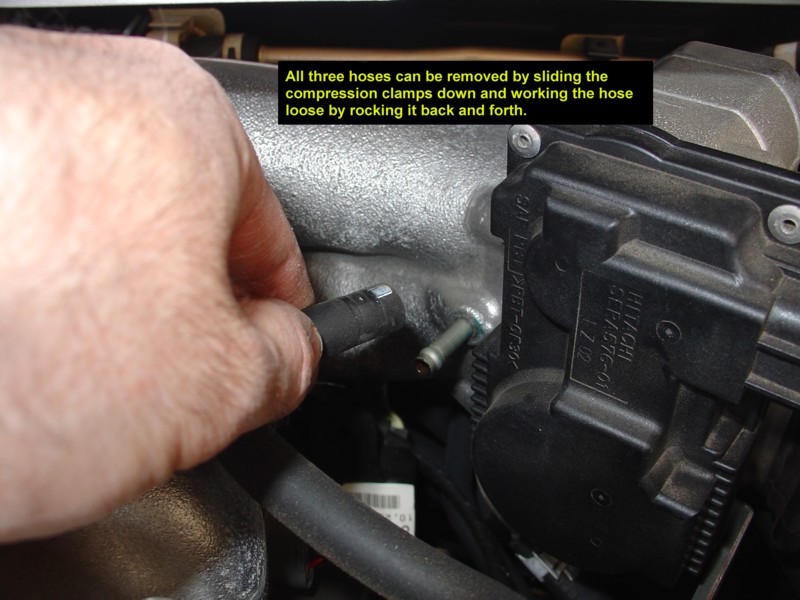
Two vacuum lines which need to come off. Slide the compression clamp down, and twist the hose off. Easy.
9
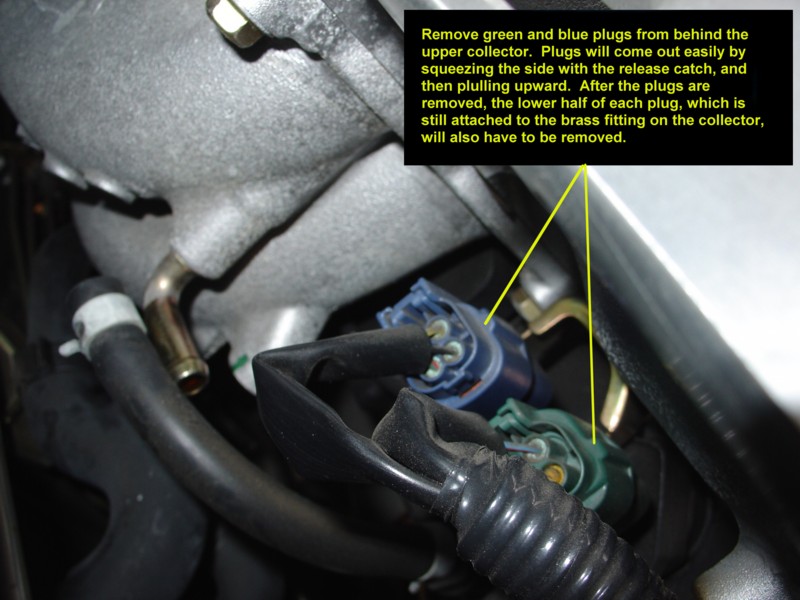
These electrical connectors need to be popped off. Be careful you don't break them.
10
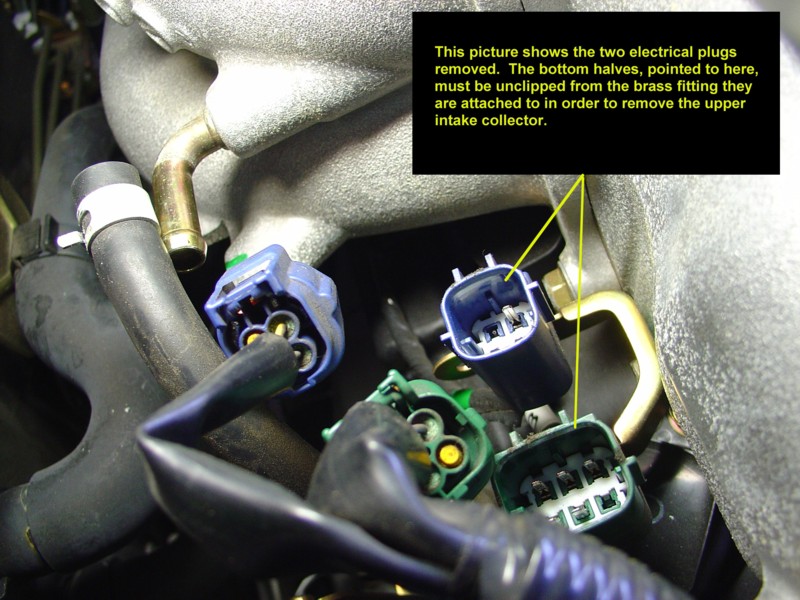
You also have to release and then slide the lower half off their brass fitting, or you won't be able to lift the collector assembly off.
11
Again, another picture before going in with the chainsaw.
12
Loosen the screw holding the rubber connector to the intake. Leave the other side alone. It will stay.
13
Unplug your "drive by wire" electrical connector, for the electronic throttle.
14
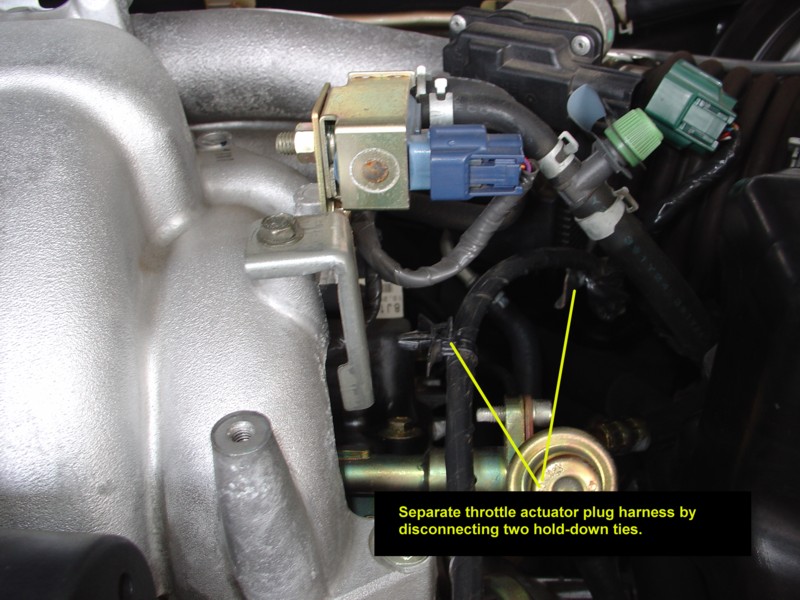
Pop out the two plastic harness holders.
15
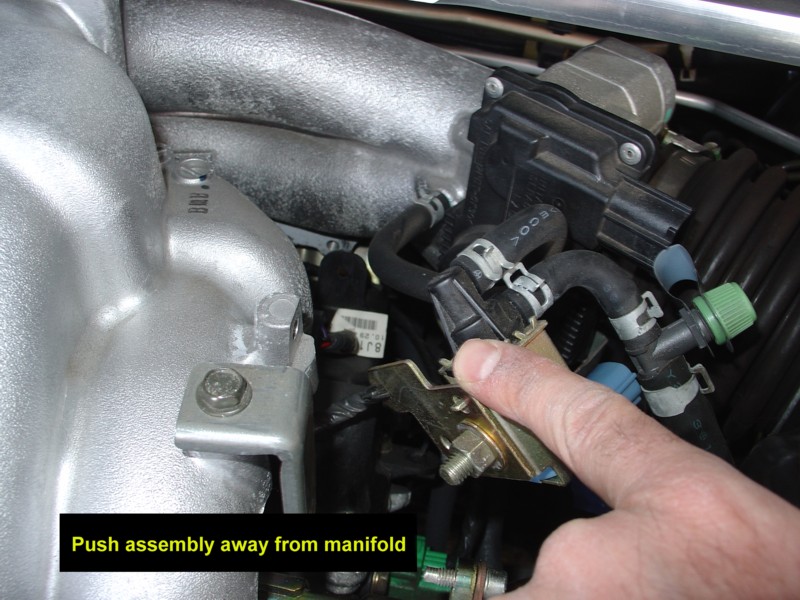
Get the wire out of the way.
16
Remove this plug, take the 10mm bolt out, then put the plug back in.
17
Make room.....
18
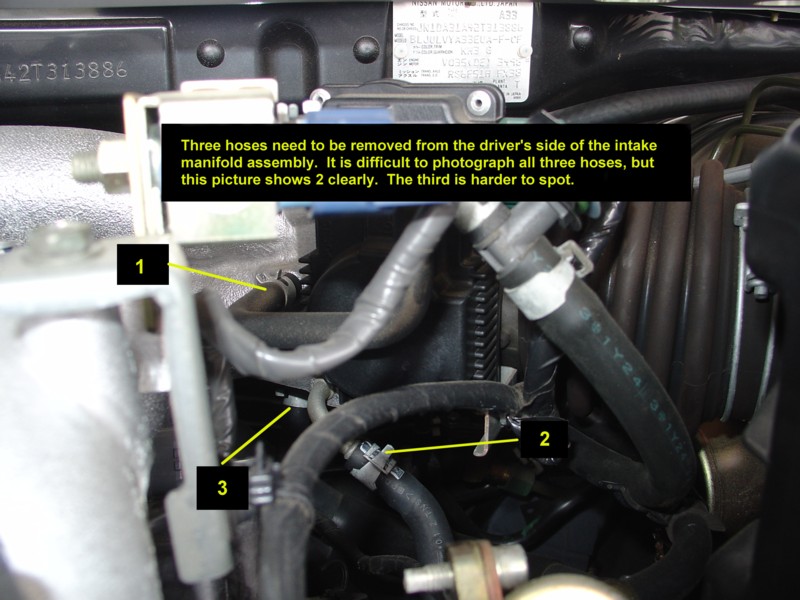
This was a tough picture to take. A little trick here - disconnect hoses 1 and 2 right at the area pointed to by the yellow line. Be prepared for a little bit of coolant to spill out when you disconnect hose #2.
Important - disconnect hose #3, not where you see the yellow line here, but at the other end of the hose. You will never in a million years reach this hose where the arrow is pointing, but you can reach it at the other end.


Slide the compression clamps down before you try to take these hoses off.
19
Just another view at lines #1 and #2.
20
Removing hose #1.
21
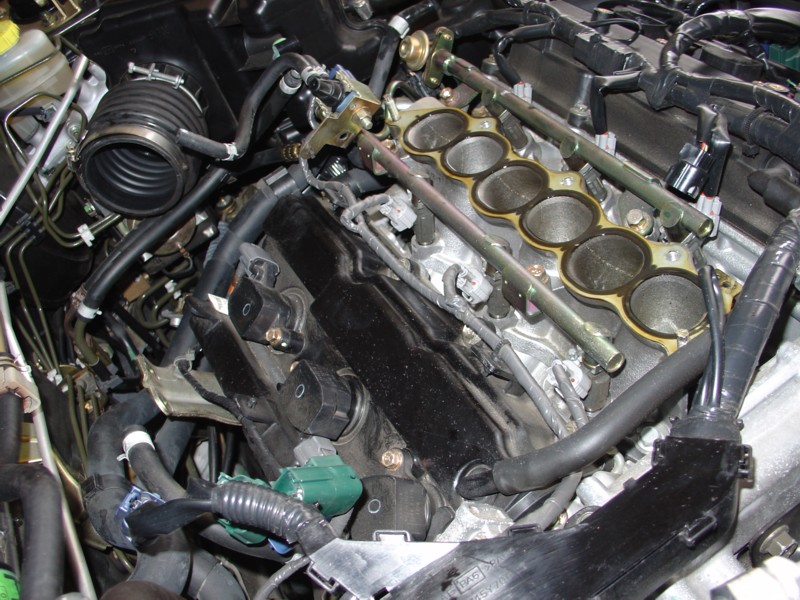
After all of the hoses and electrical connectors come off, you can lift the entire intake collector assembly up and out. This is what the engine bay looks like with the collector assembly off.
22
Another view of the engine bay.
23
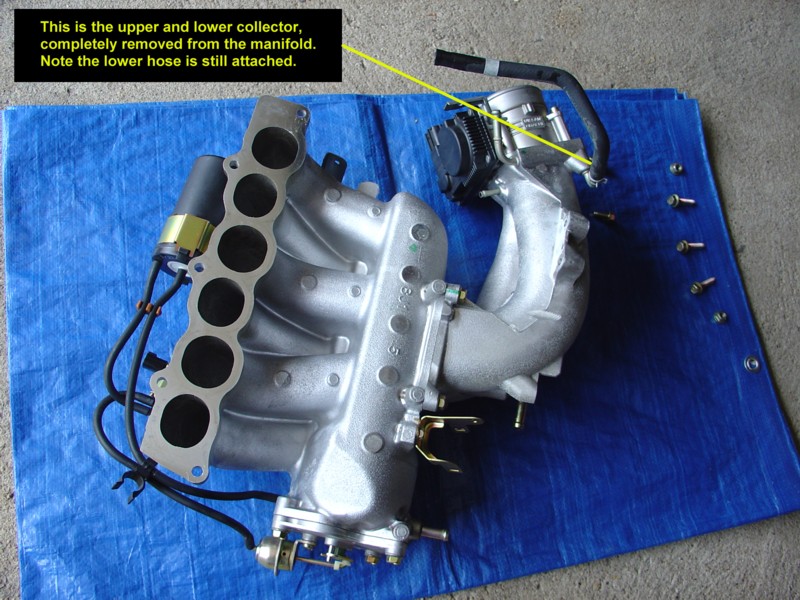
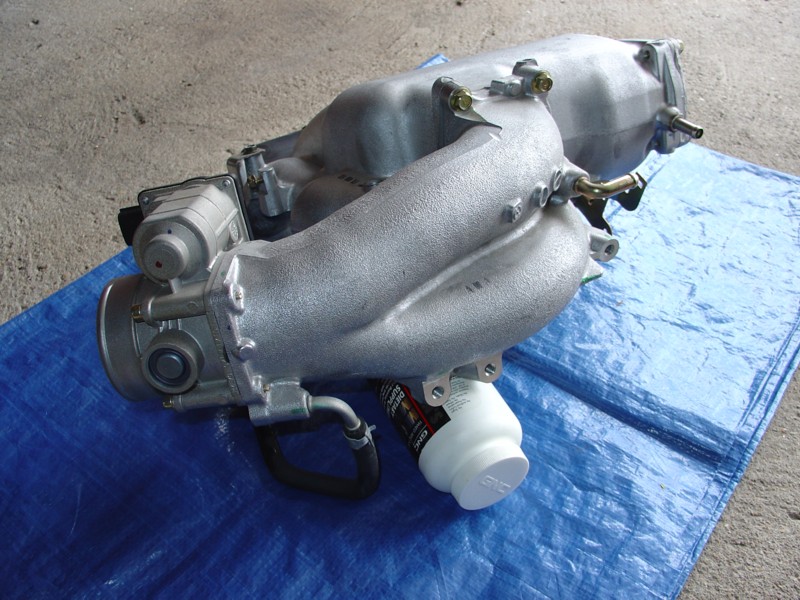
The collector assembly is rather large, but it is actually very light. I took the opportunity to clean mine up with some Gumout intake cleaner. Note that hose #3 is still attached to the collector!
24
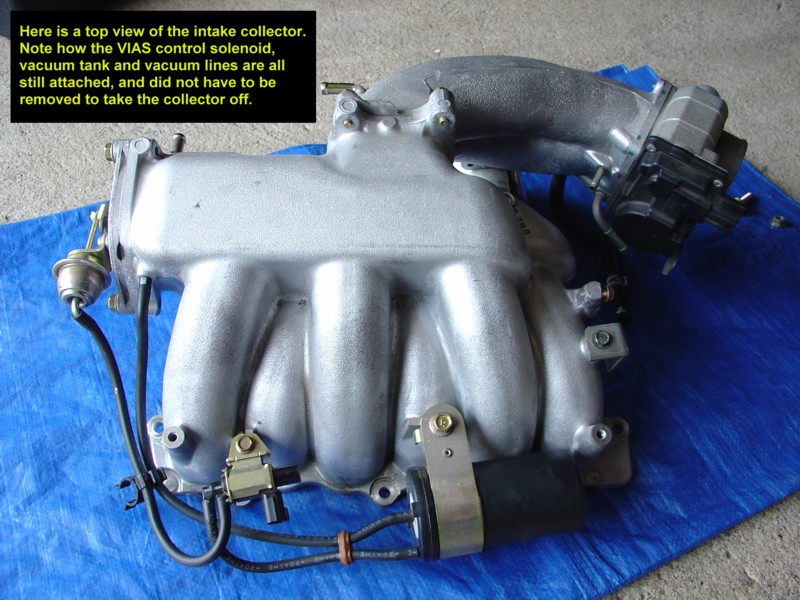
Note how all of the assemblies remain attached when the collector comes off.
25
Here is a side view.
26
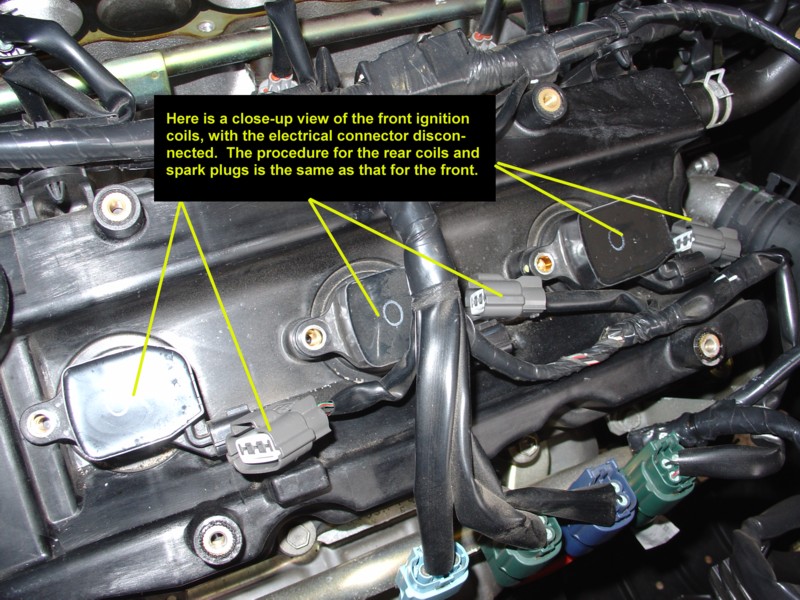
The procedure to remove the coils is the same for the front bank as it is for the rear. Just take the 10mm bolt out, unplug the connector and pull it right out.
27
This is what one coil looks like.
28
Use a spark plug wrench to remove each plug.

29

Nissan recommends you change this gasket any time the collector comes off. It is an expensive gasket, but why risk it? Buy a new one.
I do not show re-assembly here, but just follow these steps in reverse order. I hope I have de-mystified this process a little bit, and that you might be inspired to do this job yourself when the time comes. Good Luck, and you can do it.